
The United Progressive Alliance's (UPA) growth story is far from truth and is mere a statistical jugglery.
Warning against social consequences of increasing phenomenon of jobless growth in developing nations, India has said partnerships between governments and private sector can explore means of corporate social responsibility as an instrument for achieving productive employment and decent work for all.

'The policy focus of the government should have been on creating more good quality jobs but that was not their focus.'

Equity markets will take cues from global trends and trading activity of foreign investors, while in the latter part of the week the first quarter earnings from IT majors TCS and HCL Technologies would guide investor sentiments, analysts said. Markets may consolidate after the record rally last week, experts added. "On the domestic front, the Q1 earnings season begins this week. Key companies such as TCS and HCL Technologies will release their earnings on July 11 and 12, 2024, respectively.
Expressing concern over rising prices, the Congress party on Monday asked the government to deal with the issue of inflation with candour and courage and take stern action against hoarding and black-marketing.

Geopolitical events, macroeconomic data and quarterly earnings of corporates would guide the stock market in a holiday-shortened week ahead, analysts said. Stock markets will remain closed on Wednesday for Ram Navami. "This week promises to be crucial for the market as fresh worries about a potential conflict between Iran and Israel emerge.

'Generating employment requires a shift in policy.' 'If not, the country will face economic, social and political challenges in the coming years.'

Prime Minister Narendra Modi will push for stepping up global cooperation against the key issue of cross border tax avoidance and evasion at the G20 summit


'Till a few years ago, girls wouldn't take an autorickshaw alone. Now, things have improved.'
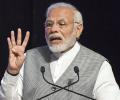
Rejecting criticism of jobless growth, he said if state after state is creating good number of jobs, how can the Centre be creating joblessness?

Moody's expected economic activity to pick up in 2020 and 2021 to 6.6 per cent and 6.7 per cent, respectively.

'If their allocation to certain segments have become high due to strong returns over the past three-four years, they should rebalance their portfolios and bring them in line with their long-term asset allocation.'

The gig economy can serve up to 90 million jobs in the non-farm sectors in India with a potential to add 1.25 per cent to the GDP over the "long term", a report said on Tuesday. The gig economy, where workers get hired typically for short durations, can lead to transactions of over $250 billion over the long term, the report by the consultancy firm BCG said. The firm said gig economy is not a new concept but has seen greater adoption following the advent of technology.
Domestic macroeconomic data announcements, global trends and trading activity of foreign investors would guide market sentiments this week, analysts said. After a record rally, markets may face volatile trends this week amid elevated valuations and investors would also keep a track of global oil benchmark Brent crude and rupee-dollar movement for further cues. "Potential volatility in the stock market is anticipated this week. Elevated valuations remain a concern, with investors now focusing on monsoon progress and its impact on the rural economy.

Top companies added employees at 3% CAGR from 2003-04 to 2013-14, while revenues grew at 18%.

Echoing Prime Minister Narendra Modi's views that improving the health of financial markets alone cannot fuel growth, G20 business leaders on Friday said vigorous efforts should be made to go beyond fiscal and monetary policy to kickstart world economy and create jobs.

According to the global financial services major, following two years of sub 5 per cent growth, India's GDP is expected to be around 5.6 per cent in 2014-15 and around 6.5 per cent in 2015-16.

Dr Ashwani Mahajan, all India co-convenor of the Swadesh Jaagran Manch and an associate professor at the Delhi University, discusses the state of the Indian economy in an interview with Rediff.com's Shobha Warrier.

The decline bolstered bets that the Federal Reserve will hike interest rates in mid-2015

The strong message from the prime minister is of continuity of policies he considers right with strong emphasis on execution, points out T N C Rajagopalan.

Fresh formal job creation cooled for the second consecutive month to decline to a six-month low in September, signalling a downturn in the labour markets this financial year. The number of new monthly subscribers under the Employees' Provident Fund (EPF) declined by 6.45 per cent to 891,583 in September from 953,092 in August, shows the latest payroll data released by the Employees' Provident Fund Organisation (EPFO). Besides, the net payroll additions -- calculated by taking into account the number of new subscribers, the number of exits, and the return of old subscribers -- increased by 14.9 per cent to 1.72 million in September from 1.49 million in August.

Chief Economic Adviser K V Subramanian on Monday said India is likely to post current account surplus in the current financial year as there is moderation in import due to under heating of the economy triggered by the COVID-19 crisis. This crisis is different from what the world witnessed during the taper tantrum, he said while addressing a virtual conference organised by industry body CII. Taper tantrum phenomenon refers to the 2013 collective reactionary response that triggered a spike in US treasury yields, after investors learned that the US Fed was slowly putting brakes on its quantitative easing (QE) program.

Macroeconomic data announcements, global trends and trading activity of foreign investors would guide momentum in the equity market this week, analysts said. Markets ended a five-week losing streak and gained nearly a per cent last week, helped by a sharp rebound on Friday. Last week, the BSE benchmark jumped 500.65 points or 0.77 per cent and the Nifty gained 169.5 points or 0.87 per cent.

The challenge is to enhance opportunities for people to generate livelihoods through entrepreneurship, both big and small, argues R Jagannathan.

Nearly 31 million Indians are unemployed and looking for jobs. While economic growth has been humming along, the pace of job creation has been poor. A revealing excerpt from Dev Kar's India: Still A Shackled Giant.
Macroeconomic data announcements, global factors and trading activity of foreign investors would be the key triggers for the domestic stock markets this week, analysts said. Last week, the benchmark indices joined the broader market's party despite a host of negative global cues. In the broader market, the BSE midcap and smallcap gauges hit their all-time highs on Friday.

Bangladesh is in turmoil, which is not good news for India, which shares a porous 4000 km border with it. There is a danger of fundamentalism growing there, and India has to move in to reset its ties with the new dispensation before China and Pakistan make capital out of it, alerts Ramesh Menon.
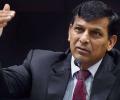
Indian economy, dubbed the fastest growing major economy in the world, is faced with the single most important pressure point of job creation, says former RBI Governor Raghuram G Ranjan as he makes a strong case for improvement of human capital through skill development. Talking about the book 'Breaking the mould: Reimagining India's economic future', written jointly by him and Rohit Lamba, assistant professor of economics at Pennsylvania State University, Rajan said one of the greatest strength of India is its human capital of 1.4 billion and the question is "how do you make it strong?" The nation needs to create jobs at every level going along the path of development, said Rajan, presently Katherine Dusak Miller Distinguished Service Professor of Finance at Chicago Booth, USA.

Non-farm payrolls are expected to have increased by 160,000 last month after rising 155,000 in December.

'You will see more and more people working independently -- starting beauty parlours, driving cars, etc.' This is what we call the gig economy.' 'The same people who have been laid off in India or are unable to get visas to work in the US may be part of this gig economy.' 'India needs billions of jobs, and it can only be created by self-employment or the gig economy.'

This brings the Fed a step closer to raising interest rates this year

This could be a major drag, not just on the empowerment of women but on the India growth story as well.

In the year since UPA went out, the GDP has grown a mere 0.5 per cent, but this government claims a healthy GDP growth of 7.4 per cent allowing it to ecstatically claim outpacing China, says Mohan Guruswamy.

'Without a poverty line, how are we to know whether poverty is the same, or it has come down or it has gone up?'

'It is building the country's infrastructure, and delivering it very efficiently.'
